|
Water
and structures.
Swiss
Expo’s Nuage sculptural lake structure and the North Sweden’s
Ice Hotel
Last summer the Swiss
2002 Expo’s exhibited a unique sculptural lake structure,
Nuage, designed by New York architects Diller and Scolfidio. Here
we explore the potential for waters fluidity integrated into structural
form, and look at how water made solid, in the guise of Northern
Sweden’s annual Ice Hotel may reflect a growing architectural
interest in the new possibilities for building with water.
by
Oliver Lowenstein
Along the
coastal road close to where I live, a cloud sits, right at the
edge of the sea and land mass. It envelops the cliffs, the shoreline
path and accompanying road, so that, looking up all that can be
seen is a sunny haze out the other side. No one appeared to be
giving neither much thought or much concern, it was one of those
beta level natural phenomena which the human species travel through
neither giving much thought or concern, unlike the wind in the
trees of a force nine gale or a beautiful deep red and ochre sunset,
or for that matter, a very clear rainbow.
The cloud
rolling around its cliff top perch brought back memories of a
visit in autumn 2002, to Switzerland’s Expo 02, and its
big highlight set-piece, an extraordinary, somewhat baffling structure
Nuage, or Cloud. Nuage extended calmly
out into the western tip of Lac de Neuchatel beside an urban town’s
lakeside space usually reserved for gentle walks and evening promenades
by the residents of Nuage’s host town. Yver De
La Bains.
 
Yves De La
Bains was one of four towns in Switzerland’s comparatively
lesser-known Three Lakes region, an hour or so north of Geneva.
Together the four towns acted as a distributed site for the first
Swiss Expo for fifty years. Each town had been provided with huge,
attention grabbing and visually arresting buildings and sculptural
structures for visitors from near and far to come to gawp at,
and wander around, either within, through, or usually, under.
Up the railway line was Neuchatel itself, with a wooden spherical
dome, home to the Expo’s rather spartan environmental contribution,
plus, floating at the shoreline a series of massive pod shelters,
host to a variety of exhibits. Further north still was the Bienne
installation, this time hugging Bieler See shoreline, a vast atrium,
with open roofing towering over the groundspace, housing sound
galleries framed within timber gantried nose cones, accessed at
one end by a long slithering pencil thin bridge which took twenty
minutes to walk across. Actually sitting in the midst of the third
lake, Lac de Moriat, offshore from the fourth of Expo’s
chosen towns, Murten Morat, France’s reputedly revered Jean
Nouvel had created a floating steel hulk, a ruddy metallically
rusted red cube, to be approached and landed on by boat. Nouvel,
yet another architectural man in black, holds up the deconstructionist
end of modern architecture in romance France.
There was
something Post Modern about EXPO.02, not only the sharp angularity,
and blitz of bright colours adorning many of the buildings, but
the fact these were temporary structures, reflecting the spectacular
but replacable razzle-dazzle aesthetic of so much Post Modern
Architecture of the last decade. It would all be gone once the
Expo circus left town. As to Nouvel, another, this time, permanent,
building, the recent City and Cultural Hall, in Luzern announces
itself brazenly. The hall is another part of where the Post Modern
turn in architecture can find itself; the buildings impregnable
fortress-factory of steel lattice work, feel on the edge of being
fascist in their aesthetics.
If public
and professional visitors were whetting their appetites on Nouvel’s
steel cube, or Bienne’s futuristic pods it was Yverdan’s
strange floating apparition which led the pack, and really caught
the eye of both public and press alike, at home and abroad, at
this the sixth Swiss National Expo. In a round up of the year
in architecture, the man from the London Financial Times wrote
that if 2001 was defined by New York’s twin towers reduced
to a pile of smoke engulfed debris, then perhaps 2002 could be
seen as the year of the cloud. Indeed, early on, the architects
the New York practice of Elizabeth Diller and Ricardo Scofidio
came to describing Nuage as an inhabitable cloud. Despite
this Nuage was very much a cloud of human creation.

Walking up
the gangway path onto Nuage, what struck me is how different
the experience is to that of being immersed in a fog of cloud.
While most people find mist and fog something to put up with,
albeit at times bleakly atmospheric, at others a merely unpalatable
way of getting soaked, Nuage traded on the novelty of
its thousands of water nozzles to recreate a delicate film of
spray, for visitor after rain-coated visitor passing through the
gantry-like steel rigging, and up the open, unprotected stairways
to the viewing deck. These visitors were apparently completely
at ease with the mundanity of what was being experienced, spray
induced dampness on clothes and skin as they made their way through
the wafting cloud of spray being gently blown back onto the lakes
shoreline. Once safe on the leeside of the cloud’s vaporous
trail, visitors looked back over their shoulders at the windblown
water heading inland, as well as the dramatic craggy hillsides
which tumbled down to the lakes shorelines, and out onto the gleaming
surface of the lake itself.
This whole
aspect of Nuage felt odd. What humans experience in nature
as primarily incidental experience – getting lightly soaked
– generally something to be complained about, could be dressed
up and sold as something which had become a unique ‘must
see’ experience. Water here was a potent appendage to the
experience industry. Indeed there is a case to be made that Expo’s
Nuage is part of a new emerging chapter in the relation
between where the man-made built environment meets those parts
of the natural environment which encompass the landlocked part
of the waterworld; rivers, streams, waterfalls, rivulets and lakes.
Through the augmentation of completely new and hitherto unseen
technologies, waterworks completely new in character and form
are beginning to become possible. This interface between culture
and nature takes on two forms, utility and pleasure, but the range
of what could be done has always been relatively limited. Until
recently human intervention into waterways consisted of managing,
that is re-channelling the courses of rivers, streams and other
tributaries, for the sake of safety, ease of transport and communication
and bringing access to water where it was needed. This also includes
constructing man-made canals and other watercourses, and diverting
flood plains into lattices of channels. River water has long been
regarded as pleasurable in and of itself, while historically the
range to which water has been put to creative ends has been limited
to the quasi-monumentalism of pumping water into fountains and
other landscaped panoramas. If these are a different category
to water as utility, Nuage is a related if distant twenty-first
century cousin to the culture of water sculpting. Fountains and
other sculptural uses of water are Nuage’s closest
structural relation since each is wholly reliant on man-made technology
for the spectacle, and in each, water is a, if not the, central
element of the spectacle. In their sculptural, and architectural
dimension, each contains a complementary point of focus. With
Nuage, however, the level of complexity, with its thousands
of computer controlled nozzles, places the exhibit far from the
relative simplicity of a fountain sculpture. Not only this but
since the spray is at the edge of turning into vapour, there is
a phase transition, between the liquid and the gaseous being enacted.
Nuages
technology is cutting edge, though strikingly orthodox. The rig
is made of steel; the structure is made up of a sixty by a hundred
by twenty metres metal construction. Woven into the shards of
criss-crossing steel, from a few metres above lake level are tiny
nozzles, spraying countless minescule drops of lake water from
31400 jets The high-pressure spraying is carried out by high-grade
steel jets with minature apertures only 120 microns in diameter,
the water being forced at a pressure of 80 bars onto fine needlepoints,
which sit directly above the apertures and are apparently atomised
into innumerable tiny droplets 4 to 10 microns in diameter. These
droplets are so small that most of them remain suspended in the
air. When sufficient jets are installed in a specific volume,
they saturate the air with moisture and create the effect of mist
or, in this case, the effect the designers, completely hip to
post-modern indeterminacy, have titled blur. The high-pressure
spraying technology ensures that the fleeting sculpture is visible
in all weathers, whether raining or sun-drenched.
 
From the Yverdans
les Bains shoreline the rig is lost in the pall of mist which
is floating in towards the land. You take your first uncertain
steps onto a long, thin ramp, visitors, and walk its hundred metre
length before arriving on a large open-air platform at the centre
of the fog mass where the only sound to be heard is the white
noise of pulsing water nozzles. These computers are continually
adjusting the strength of the spray according to the different
climactic conditions of temperature, humidity, wind speed and
direction. As a consequence the fog mass changes from minute to
minute, creating long fog trails in high winds, or rolls out when
temperature drops.
Blur was the
original working title of the project and chimes with the overall
Post Modern aesthetic of the project. The very moistness of Nuage’s
cloud also overlaps with current post-biological concepts of the
fluidity of the new moist new media, as contrasted with aridities
of clunky old new media. Continually talked-up by the media design
community moistness and flow are key features in the trajectory
set by those hoping to uncover a fully formed new paradigm in
their designs for new media’s latest future. Not for nothing
was the big European media design conference-shindig, Amsterdam’s
Doors of Perception entitled Flow. With water metaphors increasingly
common in contemporary cultural lingua franca, Nuage arrives as
a building of its time, metaphor made into physical, albeit temporary,
form.
The blurred
focus of Nuage also springs from a further source of 80/90’s
uncertainty, the emergent sciences of chaos and complexity, and
from these the emergence of a building culture which attempts
to reflect and use these sciences as the basis of their architectural
aesthetic. What seems unclear is how much the architectural community
who gravitated towards chaos, Eisenmann, Gehry and others saw
the non-human natural world as a continuous plenitude of these
sciences in living action. And within this water is an primary
exemplar as a way into observing the chaotic discontinuity of
a form.
A central
part of Chaos’s prehistory can be found in the Catastrophe
Theory work of French mathematician, Rene Thom. Catastrophe theory
was a qualitative method for modelling discontinuous phenomena,
including water. The theory models the states of nature as smooth
surfaces of equilibrium. When the equilibrium is broken, catastrophe
or discontinuity occurs. Thom showed that in natural phenomena
controlled by no more than four dimensions, there are only seven
possible equilibrium surfaces, hence only seven possible discontinuous
breaks, ie only seven elementary catastrophes. The names for these
seven are: fold, cusp, swallowtail, butterfly, hyperbolic umbilic,
elliptic umbilic, and parabolic umbilic.
These seven
forms or discontinous catastrophe’s can be found in water,
Assuming water flow as having four dimensions, length, width,
depth and rate of flow, when changes in these dimensions occur
because of changes in the shape of the streambed and variations
in the amount of rainfall, discontinuities will be brought on.
For example, if the width of the streambed begins to narrow very
gradually a fold will appear in the water’s shape. If both
the rate of flow and the depth of the stream increases, the water
may jump into the air as if jumping over a cusp.
However the four controlling dimensions change, there are only
seven basic “figures of regulation” for the water’s
behaviour. So catastrophe theory provides a formal understanding
of events or changes from states of equilibrium, for instance
discontinuous phenomena, but it has not been helpful in approaching
turbulence, which is where Chaos theory has proved itself most
effective.
 
How might
architecture and the built environment work in ‘flow’
with this non-human ‘waterworld’, both in theory and
practice to create, celebrate and learn from these fluid environments,
while at one and same time informed by growing scientific knowledge
of natural phenomena far from equilibrium? Nuage, with its appeal
to the post modern blur represents building in a post chaos and
complexity informed world. But blur is many things, often related
to the rush and inattention of city life and urban space. And
Nuage’s use of water is different, even it relies the same
handmaiden as the emergent sciences of chaos and complexity; computer
technology. Nuage infers chaos in how it channels water from one
phase transition to the next, water in cloud. But, then, so did
the steam engine.
Even so Nuage
is a unique construction, of its architectural moment, but also
part of a larger cultural undercurrent of revived attention to
the absorbing qualities humans can find in water. There is scant
evidence of buildings integrated with the medium, there are any
number of analogous waterborne experiments coursing through contemporary
culture. Does this make a movement, a wave perhaps, resurging
through the arts, creative world of makers, of if it is as it
has ever been, a small group of people in every generation always
and equally drawn to water? Whether the new chapter Nuage could
inaugurate is short lived or the beginning of a run on structural
projects which make active use of water, implementing elements
of current technology remains an open question. What is perhaps
even more interesting is the potential for Nuage type permanent
structures as part of our ongoing built environments, in towns
or cities, yet within the emergent environmental design movement
of the twenty first century. Certainly the potential and interest
for diversifying water beyond straight forward function seems
to be there. Where not so long ago design of water pathways into
urban and to a lesser extent rural settings was based around the
pragmatics of access and transportation; from water cities such
as Amsterdam and Venice to Monastically originated canal systems,
such as Northern France’s Venice Verte orchard arteries.
Today the uses can be as much aesthetic as entertainment focused
as it is practicality. Water, this already increasingly a medium
for interest, could continue to grow as a medium explored for
its potential for artistic and commercial value, rather than those,
which are purely utilitarian.
At times such
ends can manifest in surprising ways. For example, and by way
of contrast in Sweden’s northern reaches, outside the steel
town of Kiruna, the small village of Jukkasjärvi, is host
to an equally unusual project: the Ice Hotel. Built each autumn
from new blocks of ice, this building reverses the phase transition
implicit in Nuage. Rather than liquid to gaseous, the Ice Hotel
makes the physics of water solid in its state. A nakedly commercial
venture, the Hotel is nonetheless another marker of how water
is gradually increasing in being countenanced as usable as a medium
for design.
Ice Hotel
is eleven years old, and has grown rapidly as a business from
its beginnings in 1989. Each year, once the temperature has dropped
well below the freezing point, between late October an November,
builders begin using snow canons to pile on snow over a 60 metres
vaulted steel shell, up to five metres high. After two days the
vaulted shell is removed and repositioned, and ice columns are
put in place. These columns have been stored since the previous
year in a freezer storage space just off to the side of the main
Ice Hotel site. The columns are themselves carved from ice cut
from the adjacent frozen river Torne, producing crystal clear
material. The construction continues through December and the
Hotel finally opens each January.
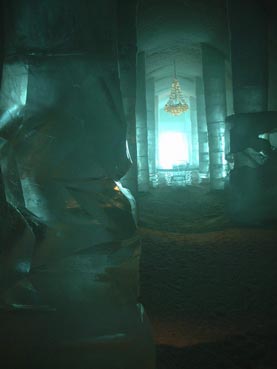
The completed
igloo is a warren of corridors running perpendicularly off a main
hallway. On each side of the corridors are rooms, each with a
customised ice sculpture, carved by a dedicated band of ice artists.
These sixty rooms are used by intrepid or foolhardy overnighters
who bag down on wooden bedding and suitably Viking fur covers.
At the oversized igloo’s epicentre is a bar, a deal made
inevitably with Absolut, which is there for those staying to while
away the time. Outside are further cabins and lodges where visitors
can either stay the during the night, or risk the ice hall. During
my visit, opinions seemed to differ as to how much people actually
enjoy, rather than endure, the night in their neck of the warren
of rooms. To package the visit as a complete experience the Hotel
offers any number of other activities such as teambuilding, fishing,
wilderness adventures, to snow-mobiling, dog sledding, and reindeer
safaris. Its novelty has brought the reach of tourism to the far
north, a place where the snow and ice have historically kept visitors
to a minimum. Now the tourists arrive by the plane load, flown
into Kiruna airport, and bussed to the hotel for the three or
four day Ice Hotel experience, before departing again having been
there, and done that. Another child of the experience economy
of today’s tourist industry, much of the Ice Hotel is seriously
kitsch. Yet it has demonstrated how ice itself is a strange and
rich medium. While I was exploring the igloos passages, shards
of light broke through from the buildings exterior, bringing out
the most beautifully translucent quality which stopped me in my
tracks. At night when the ice was lit with coloured artificial
lighting there was an uncommon peace to the pillars and interior
walls.

Although the
Ice Hotel is not an architectural experience, it does demonstrate
human ingenuity with this strange material from the natural world.
Whether it improves on nature is another matter, but with tourism
expanding exponentially, expect the Ice Hotel franchise to likewise
expand in northerly climes. There is talk of another Hotel in
Canada, as well as a plan as of early 2002 to build a mock Shakespearean
Globe theatre from the material. Along with the hotel it will
melt each year come the thawing springtime of April, only to return
again, remade, in the late autumn months.
Both Nuage
and Ice Hotel demonstrate, albeit in wholly different ways, the
increasing interplay and exploration between contemporary technological
know-how and the one element which has been used by man in diverse
ways down through the ages – water. From tidal mills to
weirs, to canal systems and steam engines water is the more versatile
of the two elements which can be put to structural use; the other
being earth. The resurgence of interest in water is occuring across
the creative field. There are many disparate experiments happening
in the arts in recent years, such as Land artists using ice and
water as medium and subject matter. The flow and other water metaphors
are increasingly part of the currency of descriptive language,
with aquatic ballets and phase transition performance pieces,
it isn’t surprising that something similar is being expressed
within the terrain of the built environment. The monitoring control
of water made possible by computer systems and the possibilities
of a deepening sophistication on how to interact with water will
continue to grow. Allied to research in emergent scientific disciplines
of complexity and chaos studies, a whole new dimension of the
emergent architectural movement may be in the process of unfolding.
If Nuage and Ice Hotel are wholly hi-tech expressions of this
phenomenon, they do not exclude the possibility of the development
of lower tech structural concepts which embrace both complexity
and emergence through the medium of water. All in all, it seems
likely that water will play an increasingly visible and apparent
role in how we envision and create our surrounding environments
in the coming years.
www.designboom.com/eng/funclub/dillerscofidio.html
www.dillerscofidio.com
www.wetdesign.com
|

