|
Return
of the Cruck Frame - Homegrown and Re-invented
Over 800 years old
cruck-frame building is enjoying unprecedented and renewed popularity.
Two new buildings – the Sheepdrove Biodiversity Centre and
Ben Law’s Prickly Nut Wood – demonstrate contrasting
contemporary applications to this traditional timber framing method.
by
Oliver Lowenstein.
In the last
eighteen months two very different buildings have been completed
which are at the forefront of a contemporary resurrection of a
medieval building form which stretches back some 1300 years. These
two, the Sheepdrove Biodiversity Conference Centre in Wiltshire,
and Ben Law’s entirely self-built domestic home within his
own wooded land in West Sussex, bring elements of cruck-framing
into the twenty-first century. Cruck-frame construction utilises
the natural curve of the tree, stretching from the roof, down,
or significantly close, to ground level. At the apex there is
often a ridge beam, so that the cruck-frames, along with purlins
and bracing, carry the roof load, thus making the walls’
load bearing function redundant. These two new cruck-frame constructions
are both variations of an essentially simple building technique,
old examples of which remain around parts of the country, a source
for a cruck-frame centred renovations industry. They are also
vastly contrasting buildings, Ben Law’s home uses round
wood, while Sheepdrove stays with milled timber, but between them
they span two ends of this part of the timberbuild spectrum.

Image
by Adam Wilson
The Sheepdrove
farm building is an ambitious timberbuild project, adapting the
cruck-frame to modern engineering. The £2.7 million building
is a new arrival on the millionaire and ex-publisher Peter Kindersley’s
2000 acre organic farm (one of the largest in the country.) From
the exterior the building is neither wildly exuberant, nor understated,
a solid eco-pragmatism expressed in it’s L shaped south-facing
lay-out. Built as a sixties model farm in a hollow in the Wiltshire
downlands, which is also a protected area of outstanding natural
beauty, Sheepdrove Farm has since its origins, never actually
contained a real central focal point, or hearth to it; and it
was this absence which Kindersley, not a man to do things by halves,
decided to address in building what is essentially a contemporary
long barn, to serve as a non-institutional eco-conference centre.
A man accustomed to thinking big, Kindersley wanted a building
unobtrusive from afar and sitting comfortably in the Wiltshire
downland, which at the same time provides a sense of drama and
expression. The result is a building of timber drama, designed
by the Bristol Architects Alec French Partnership and Mark Lovell
Design Engineers.

Image
by Adam Wilson
The ‘visible
expressed structure.’ or external expression of the 160
foot length barn (the vertical line of the L), is primarily in
the long roof which, because it is supported by the cruck-frame,
rises steeply to two narrow flat parallel ridge roof elements.
Along the south-face of the barn are a series of three sizeable,
rectangular glass window facades, decked with horizontal overhangs
to provide protection from the weather. The 55 metre by 30 metre
building mixes a layer of Canadian western cedar cladding along
the vertical first floor wall, followed by shingle on the roof
slant and further cladding on the upper roof ridge, along with
concrete rendering on the building’s south face and more
interestingly, a rammed chalk wall experiment along its north
side. On the barns’ eastern perimeter is a herb garden.
One third of the way along the barn, an office complex runs at
a perpendicular right angle, completing the base of the L shape.
Joining the two, and comprising a two thirds externally visible
arc, is a radial turret tower, decked out with a faux pagoda steeple
– originally envisaged as Kindersley’s eyrie - overlooking
somewhat panoptican-like, the main farmyard, landscaped with a
pollarded square of trees.
Image
by Adam Wilson
Once inside
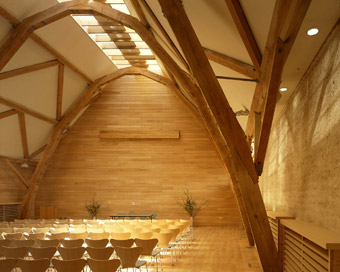
the dramatic expressiveness continues. What the project’s
engineer, Mark Lovell, calls a jointed cruck system holds the
building together. Four of the buildings twelve vaulted arches
are fully visible in the main hall, for conference visitors to
admire and relax under. Entering by way of the tower’s ground-level,
the main hall to the left of the entrance is a large volume, high
ceiling space suitable for conferences of up to 200 people. The
stand-out interior characteristic is also the core structural
feature: the vaulted arches rising high, meeting in the middle
(and carry the load bearing) of the roof.
This modern
interpretation of jointed cruck-frame construction, is achieved
by a series of four ribs on each side moving from a steep incline
to nearly horizontal across the roof ridge, so that, degree by
degree, the whole system gradually bends into a deep parabolic
half barrel shape, mimicking a natural curve in its arc from one
side of the building to the other. Because of the arc both columns
and rafters are avoided, opening up the space, and drawing together
walls and roof as a single structural element. The cruck-frame
construction is linked by a series of purlin braces supporting
the roof between each vault. The vaulting ribs were designed to
reduce the use of metal brackets and rods to a minimum, although
each rib is bolted onto the next. Cruck-frame construction was
one of three approaches developed by Mark Lovell Design Engineers;
Kindersley chose the simplest.

Image
by Adam Wilson
The cruck-frame
was originally conceived to be constructed from recycled 4.5 metre
wharf and mill floor beams, which are abundant and can be dismantled
from disused Northern city industrial sites, but they have only
a limited range of re-usability functions, being too large for
domestic and too small for current industrial build. But after
an extensive search the contractor stated that this would be too
complicated an avenue to pursue, and the project team reverted
to Douglas Fir. 225 mm square these hefty pieces of timber were
milled in Northamptonshire, and constructed off site, before being
transported to the farm and raised, to comprise the barn’s
skeleton. The wood for the cruck-frame is Douglas Fir, and the
cedar shingles was also originally to be sourced from Scotland,
but the right timber wasn’t available and an eventual decision
was made to go with Canadian Cedar. The cruck joining system derives
from boat construction, borrowing the method for joining a boat
between the keel and the prow, a section called the keelson. While
the full extent of the cruck-frame vaults are visible in the main
hall, providing a space with a calm-inducing sensibility, the
Douglas fir sandblasted interior immediately provides something
of an old, almost primeval feel. The rest of the building includes
a smaller second floor 60 person conference room and a restaurant,
where some of the structural material has been hidden away.

Image
by Adam Wilson
Technically,
for ventilation, air is piped in at a low level, and leaves at
high level, with louvres in the middle so the air doesn’t
move back through the building, a system developed by Paul Roosevolt
at Energy Sustainable Design. Control systems are also used to
detect C02, which is monitored from a PDA, and once the control
level overruns this triggers vents opening. There is also controlled
underfloor heating which can adjust automatically to heat the
fabric of the building, for instance, early on a Monday, after
being off all weekend. While Architect David Mellor acknowledges
there’s substantial hi-tech equipment involved he sees the
building as lo-tech in its general approach. In terms of embodied
energy the hardcore is low in cement content, although it is the
rammed chalk wall, with the chalk dug straight out of the ground
and compressed into rammed chalk which is the most experimental,
originating in Lovell’s experience with rammed earth at
the Earth Centre, though also local examples of downland cob and
chalk dwellings.
As another
sizeable timberbuild project coming on line the Biodiversity Centre
is interesting as a further example of how wide-span timber design
can be realised, without resorting to columns. Bearing some comparison
with the Weald and Downland Gridshell, which, after all, is also
essentially a barn, and, maybe too, the Sheffield glulam designed
Winter Gardens – though this latter is essentially a glasshouse
- this modern reinterpretation of a cruck-frame in showing how
essentially environmentally friendly large-scale buildings can
be designed. At the same time, unlike these other two examples,
the Biodiversity Centre, as a cruck-frame is part of a very long
tradition in British vernacular buildings. This means it predates,
and almost leapfrogs the twentieth century revolution towards
lightweight structures. Indeed, inside the building the sizeable
timbers definitely draws the eye. Lovell argues that this means
the building will last, and also contend well with possible accidents.
As such, its completion does present a distinct counterpoint to
the current trajectory of lightweight timber structures.
If it brings
renewed interest in cruck-frames, the Biodiversity Centre will
be well within a long tradition, for cruck-frames are a key part
of Britain’s vernacular architectural heritage and history,
historians dating their first construction to around the time
of the eighth century. Intuitively it is easy to imagine the structural
idea could well derive from much earlier times. And certainly
other parallel examples, for instance Arctic peoples building
shelters from the natural curve of whale-bones, can be picked
out from the deep past. In Britain however, cruck-frames were
a popular building form through to the fifteenth and sixteenth
centuries, for domestic and agricultural buildings, in the main
because of their structural simplicity. There are two distinctive
cruck frame forms, the Full or True cruck-frame, and the jointed
(or Scarf) cruck-frame, although there are at least six derivations
of these main two types, defined in part by a variety of joint-forms
for bearing the roof load. The origins of cruck-frames are uncertain,
particularly since so few buildings remain from earlier than the
13th century. Timber frame building historians are quite open
to the form having originated separately in several places around
the country. The geographical spread is primarily in the west
of the country, with True crucks appearing in the West Midlands,
the North-West and the West itself, but completely missing from
the south and south-east, while jointed crucks are mainly found
in the South West; Devon, Dorset, Somerset and Wiltshire, appearing
to have originated in Somerset, with some spread northwards up
the West Coast. Their absence both from mainland Europe and the
South East suggests that cruck-frames were indigenous to Britain.
In fact it is likely the influence worked the other way round,
with mainland Europe (as always) influencing England’s most
economically and culturally dynamic region – the South East
- with more advanced building forms1. Today there are many remaining
cruck-frames across these parts of the country, supporting specialist
timber-frame renovations companies. Historically, alongside and
as well as the cruck-frame, the much more common and versatile
box-frame, continued to evolve through the centuries moving further
and further beyond what could be achieved with cruck-frames. By
the 1700’s cruck-frame construction had become essentially
a less efficient and outdated building technique, compared to
the elaborations of box frames. As wood supplies rapidly diminished,
the cruck-frame faded away, except for a few isolated examples
in the north.
Ben Law’s
cruck-frame at his Prickly Nut Wood home feels much closer to
the more usual historical story of cruck-frames. Law’s dwelling
maintains the traditional and partially medieval link to carpentry,
even if, looking from afar at least, it also has definite new
age ‘natural house’ overtones. There are many differences
between Sheepdrove and Prickly Nut Wood, but one major contrast
is that the scale of the former demands an essentially engineering-centred
solution, while Prickly Nut Wood is a carpentry-centred building.
A man attracted to living out the beauty of small-scale solutions,
Law is a long time stalwart of the Permaculture movement. It applies
the permaculture system of working, which respects and partners
the ecosystems of the land, as much as humans’ needs of
the land, to a woodland context. For those who are not familiar
with Permaculture it applies radical agricultural methods to the
land, re-calibrating normal agricultural practice so that it is
of mutual benefit to the eco-system as it is to the permaculturist
tending it – the aim being to be both ecologically practical
and benign. For over twelve years Law has owned and worked 100
acres of mainly chestnut woodlands in the noticeably more rural
side of West Sussex. He describes himself as a traditional woodsman,
working his particular neck of the woods, primarily charcoaling,
making furniture, and coppicing wood for fencing.
After several
years of living literally outdoors - in benders and a rusting
caravan, Law began to make plans to build his own home from his
own wood materials, through the most ecologically efficient lo-tech
means; which in effect meant the carpentry-centred craft approach.
In 2002 after years of difficulties gaining planning consent,
Law and a band of volunteers built the dwelling over a summer
period of seven or so months. Law’s entwining permaculture
with his house building, as well as his prolonged dealings to
obtain building permission is explored in full in his book, The
Woodland Way.2
Two years
on and a certain mythology has grown up around the house, not
least because the building process was filmed for an episode of
Channel 4’s Grand Designs series. As a result, like it or
not, Law and his house have gained a reputation, albeit on a small
scale, well known on the alternative scene which fuels much of
Permaculture and associated rural idyll dreamings. When I tried
to arrange a visit, Law, asked me not to, stating over 1000 people
had visited last year, and he wanted some privacy. As a result,
the description which follows is the result of repeated viewings
of the Grand Designs programme and conversations with Law and
others involved in the building and permaculture, but no first
hand visit. It has to be said, there was an aspect of surrealism
watching wholly different worlds colliding in this programme;
the intensity of eco-correctness pursued in all its colourful
detail through the eyes of the camera and the unctuous, though
apparently genuinely bemused presenter, and on the other hand
ads breaking in every twenty minutes for Mazda or Vodafone3.
Given that
Law wanted to create his home in and from his own woodland and
given that British planning regulations are organised to protect
woodland from any building it was initially very difficult to
get anywhere with gaining planning permission to build a new home
of any type. At first it was impossible to get West Sussex’s
local authority even to consider the application. After several
years sheer persistence, the planning regulations were finally
interpreted flexibly enough to accept Law’s argument that
his coppicing business constituted a genuine reason to reside
on his own land in the wood, and Law’s dreams of realising
his building began to take on an air of real possibility. The
argument that finally won the day was that he needed a home to
fulfill his responsibility to look after the wood, as well as
maintain his business. However, the accepted application is ring-fenced
into his woodland work and he is not allowed to sell the house
on, if he stops working the land4.
What is unique
about the Prickly Nut Wood dwelling is how, following Permacultural
principles, the form, design and size of the building are determined
by the materials immediately available from within the woodland.
Law must have thought about the plan for a long time as the floorplan
is exacting, measured out to the inch by straw bales, which are
used as the main wall component.
In the early
summer of 2001 Law and an assortment of friends and volunteers
under initial guidance of carpenter, Viv Gooding, constructed
not only a unique roundwood building, but one of the few contemporary
cruck-frames built as a domestic home in Britain. Over the length
of an early summer day and using eight 30 foot sweet chestnut
trunks Law had individually chosen from his woodland, the crew
raised four cruck A-Frame’s, balanced with a ridge-pole
main-beam running the course of the cruck-frames. Following the
path of as low tech and low environmental impact as possible,
Law forwent scaffolding and crane machinery, using a human powered
system of pulleys, ropes and a winch to put the initial mainframe
in place. Once up, the simple triangular cruck-frame is one of
the strongest forms in terms of compression. Using joining techniques
that originated, like the cruck-frame, in medieval times, hand
cup oak joints, where a cup is carved out, were made. From these
well-seasoned, dry dowel heads were cut and manuevered into the
joins, following this up with a peg to lock the dowel into the
join.
With the round wood cruck-frame in place, and looking something
like an oversize triangular toblerone skeleton, the building team
began laying the floor and extending the veranda outwards. At
the same time the frame was strengthened with a cross brace system
of hand chosen diagonal sweet chestnut direct from Laws’
coppice, each piece individually chosen for the appropriateness
of shape as well as an intuitive sense of character. Peeled of
bark, these were cross-braced between each of the four Cruck A-frame
sides. For the roof a water proof membrane along with rafters,
preceded a heavily overlapping shingle roof, composed of 12, 000
individually cut and pre-drilled shingles (to avoid the danger
of splitting), which Law had prepared over the preceding months.
This method of preparation had been used across the channel on
continental Europe, “for years,” and has a life expectancy
of forty or so years. The chestnut gives the roof a strongly matted,
textured sense and in time will turn grey. The next step was to
install warmcell insulation, a ‘breather’ membrane,
and 300 16 inch straw bale walls, as further wall insulation bought
from a neighbouring farm. Since the house had been measured in
bales, each section of bales slips in exactly between the studwork
frame, like a carefully composed kit. The windows, therefore,
are bale height. Internally the plan’s design provides a
bedroom, open kitchen-living space, and bathroom. Externally,
Law next applied ‘wavy’ edged board over the studwork,
before digging out clay from a pond within his woodland, mixing
it with water, sod and straw to make up plaster, which he filled
in over the straw bales. Lastly he added the windows, a large
arched front window, further windowing on each side, including
three roof windows which allows the main room, with its ceiling
free, open cruck braces, to flood through with light. All these
window frames were personally built from coppiced ashe, with their
catches made of yew, There is a rayburn, an organically shaped
clay cob fireplace and his bedroom is painted a restrained red,
a mixture of iron-oxide and tumeric.
Outside the
house is an array of solar panels, previously redundant after
their life cycle ended on TV’s Big Brother programme. These
supply half a kilowatt of power, stored in ex-submarine 2 volt
batteries; enough to run Law’s lights, laptop and stereo
independent of the grid. Law originally estimated a budget of
between £20 and £25, 000. In the event the price overran
to £28, 000, because of an under-estimation on the glazing.
From the television programme the (almost) finished home feels
very much in architect and the Eco Design Association founder,
David Pearson’s, ‘Natural Home’ mould, and the
appeal it has attracted amongst a curious public makes sense.
Indeed Maddy Harland of Permaculture magazine describes it as
the most ‘natural house’ she has stepped into. Not
only this but Law has lived out his dream, something many of us
have a lot of time for.
Indeed, there
is an intense idealism to Law’s Prickly Nut Wood home, and
it is a remarkable achievement and show of perseverance to stay
with a project that initially seemed so unlikely to be permitted.
That it has done provides an appealing example of a pure and unadulterated
ecological way of living and being, which addresses many issues
about rural living, and inspires thoughts about the possibility
of a future for woodland communities. Patrick Whitefield, one
of the best known practitioners within the Permaculture community
and author of How to Make A Forest Garden, acknowledges that,
pragmatically, it is not a path open to everybody, although he
comments that it could one day possibly become a mass building.
He ponders whether six further buildings may be being constructed
on the basis of Prickly Nut Wood’s sphere of influence.
Quite possibly. Law refers to two other cruck-frames, he knows
of one at the Greenwood Trust in Shropshire, the other by Mike
Abbott of Living Wood in Herefordshire. Law says he, “would
like to think that it’s the start of a re-emergence of cruck-frames”,
although he points out that Prickly Nut Wood is primarily a showcase
for chestnut as a ‘large durable timber’, given the
prolific chestnut roundwood found in the south-east, rather than
being about cruck-frames in themselves. Whitefield enlarges on
the context, stating that Permaculture is ‘a minority amongst
minorities’ and contra-indicated to the current economy,
while organic farming is demonstrating itself relatively well
suited to modern ‘natural’ capitalism. Whitefield
believes Permaculture will come into its own in the future, by
implication a future where things have changed. Law’s building
can be said to bring the practice of Permaculture into the living
room. In setting the precedent, Prickly Nut Wood suggests all
sorts of possibilities for future rural-forest living. Certainly
it is a significant addition to the repertoire of examples of,
and also the debate about rural living in the early twenty first
century, in terms of chestnut as a sustainable material, the practical
application of Permaculture principles, and another strand in
the greenwood forest community story begun by John Makepeace’s
1990’s Hooke Park project, and presently being taken a next
step by the Flimwell Woodland Centre in the east of Sussex5.
From another
perspective the apocalyptic vision which Permaculture integrates
into its story about itself, is alien – and arguably somewhat
alienating - to much of contemporary society. My sense of Permaculture,
and Prickly Nut Wood as a building analogue of Permaculture, is
that the movement appears to exist in a parallel universe, where
the contemporary consensual hallucination known as ‘reality’
has somehow been made to unhappen. The implied tenacity of Law’s
dwelling, its duty to example, fuels a sense that catastrophe
is not only upon us, but has already passed by sometime ago and
this is post eco-apocalypse survivalism in action. But then again,
maybe it has. It is interesting that Permaculture is almost an,
albeit off the map, alternative to Organics. As Sheepdrove is
future oriented organic farming and Natural Capitalism at full
tilt, so by extension the Biodiversity Centre is to Future Organics
what Prickly Nut Wood is to Future Permaculture. Not only this,
but the one rules out the other; you couldn’t build the
Biodiversity Centre using the principles applied at Prickly Nut
Wood; the latter would not be what it is if it had used the building
principles of the former.
Prickly Nut
Wood is a contemporary vernacular of the cruck-frame tradition,
and in many senses completely medieval in values, give a solar
panel factory here and a computer plant there. Sheepdrove is also
medieval, but a different medievalism. Law talks of his home as
a temple to wood, and Mark Lovell uses similar ‘new age’
inflected language about Sheepdrove, words like ‘ecclesiastical’
and ‘purity.’ But the Biodiversity Centre also contains
elements of modernity in its millennial medievalism; both industrial
engineering and a streak of real-politic runs through it. This
suggests that in this specific sub-current of the architectural
realm, as in the wider cultural sphere, as Umberto Eco pointed
out, there are a multiplicity of medievalisms’ still diversifying
and cross-fertilising6. If this is the case expect to see further
cruck-frames both on the drawing board, and literally going up
before your eyes.
Yet while
there are differences, each are, albeit different, ways of doing
building. The difference may in the end come down to money, a
rich man/poor man divide. Whether the earth can sustain the economics
which facilitates a Sheepdrove a hundred years from today, or
will of necessity and climate change be plunged into the kind
of future Permaculturalists foresee encapsulates the question
which separates the two.
www.alecfrench.co.uk
- Architects of the Sheepdrove Biodiversity Centre
www.mlde.co.uk
- Design Engineers for Biodiversity Centre
www.permaculture.org
- main Permaculture website with links to Ben Law’s Prickly Nutwood
project
www.carpentersfellowship.co.uk
- carpenters guild group, including information on the annual Frame
conference
|

