
Hackney, the unlikely world centre of urban CLT buildings
North London’s inner-city borough has become the urban hub for cross laminated and timber engineered construction and architecture. The borough was also close to becoming Britain’s first Wood First council. But then things got complicated.
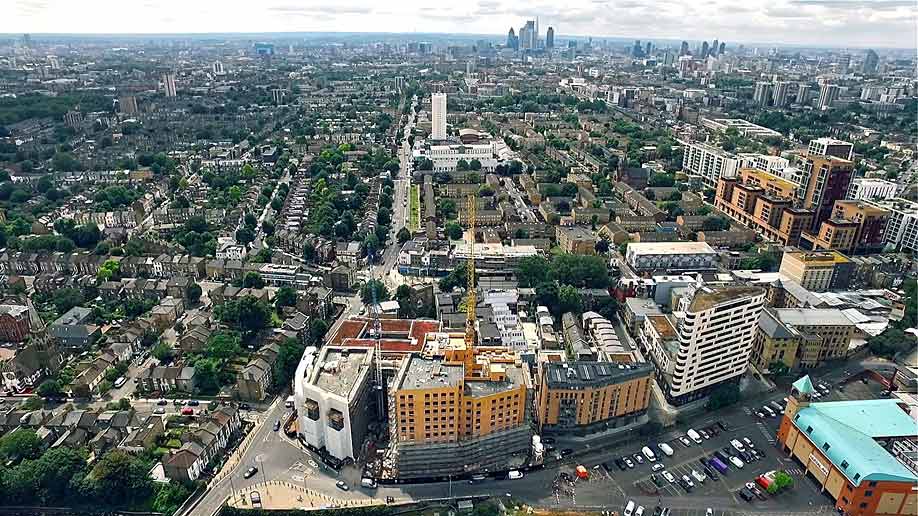
From the air, Dalston Lane (today Dalston Works) under construction
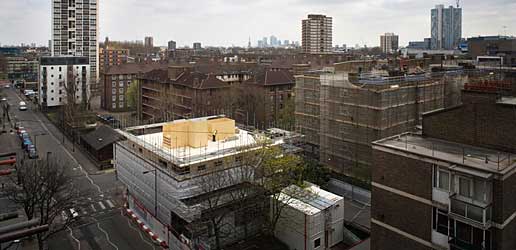
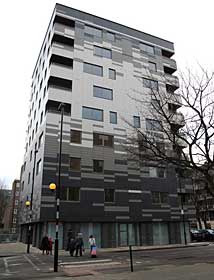

Murray Grove – Photo’s WaughThistleton Architects
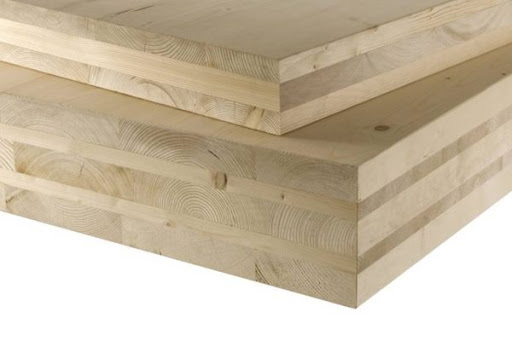
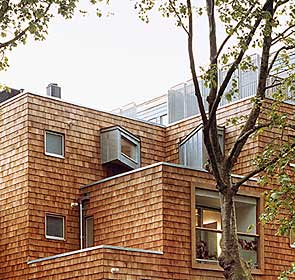

The UK’s pioneering CLT company, Eurban, also built one of the first CLT buildings in Hackney, Quay2C’s Waterson House
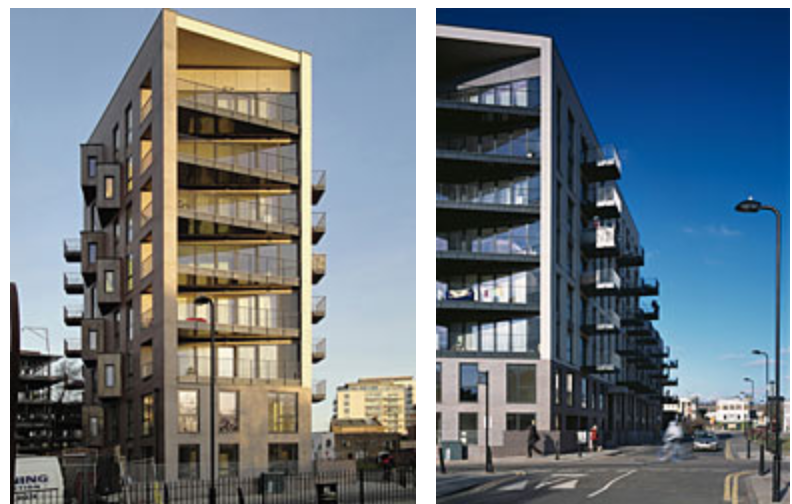
KaracuvicCarson’s Bridport House – Photo’s KaracuvicCarson Architects
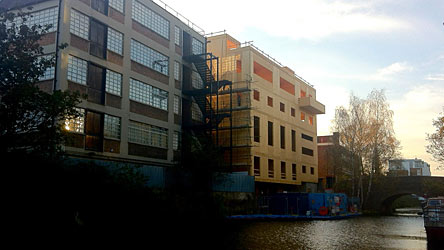
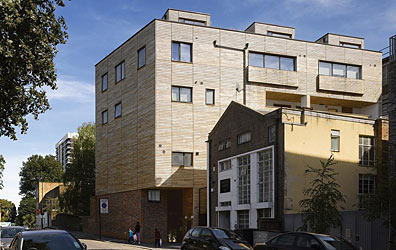
Whitmore Road by WaughThistleton
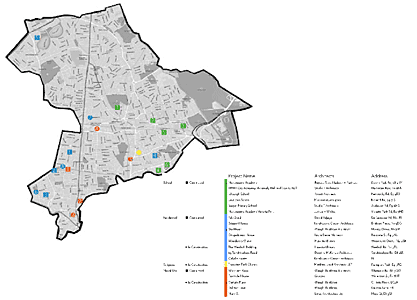
WaughThistleton conducted a review of Hackney’s wood building projects Hackney Council, including this map
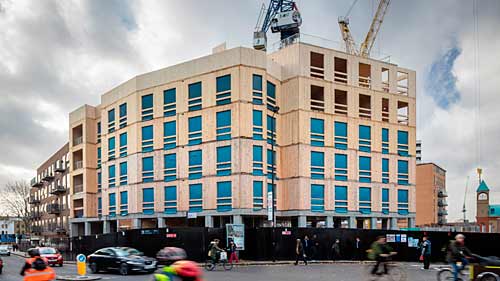
On the ground – Dalston Lane – under construction – Photo WaughThistleton
In Britain’s capital, London’s North-Eastern borough of Hackney has been known as one of the poorest, diverse and multicultural municipalities. With a population of 250 000 it is round Europe, and indeed different parts of the world, however, Hackney is increasingly identifiable an entirely different, and, on the face of it, surprising, reason, as a world leader in urban CLT buildings and construction.
“I was at Graz Technical University a few weeks ago”, says Andrew Waugh of the Hackney based WaughThistleton, “and Gerhard Schickhoverwas saying how Hackney and the WaughThistleton offices have become an international CLT centre.” Waugh’s office hosts weekly visitors, including in the last weeks an Oregon mayor and a leader of a Swedish town council.
Today Hackney is home to thirty-five CLT projects, including WaughThistleton’s Dalston Lane, currently the largest CLT project in the world, a number of KarakusevicCarson housing blocks, and Hawkins-Brown Wenlock Road, (although some argue this can’t be considered genuine CLT as it is only used as a secondary material to the concrete core rather than structurally.) Dalston Lane is a mixed use, housing, office and retail comprising 121 housing units, with 3500 sq metres of office space, the building is to use 33, 500 cubic metres of CLT.
How did this unlikely turn of events happen? After all, prior to WaughThistleton’s Murray Grove (or StadtHaus as it was originally known) in 2007, Hackney wasn’t really on the timber-building map at all. Eighteen projects are admittedly a drop in the ocean, but in the UK CLT only really began taking off in the second half of the 2000’s, when some among the more mission-driven in the sustainability building network kick-launched a small number of early projects, including Eurban, dRMM and Murray Grove arguably doing much to propel CLT into the architectural and engineering mainstream.
Murray Grove and subsequent projects demonstrated to Hackney’s already proactive local planning department the potential of CLT, in a department already proactively committed to both carbon reduction and increasingly, the use of natural building materials. By 2012, CLT had established itself thoroughly in Hackney, and its use in the Government’s ambitious national Building Schools for the Futureprogramme had also begun popularising the material. WaughThistleton had moved, after a seemingly transformational meeting Hermann Kaufmann towards becoming a far more timber-centric practice. Murray Grove had been criticised, not least by CLT pioneers dRMM’s Alex de Rijke, for looking like any mid-rise, rather than exploring timbers structural and design potential. The recession was waning, and new projects, including KaracuvicCarson’s Bridport House were finishing across the borough.
Early the same year David Hopkins had been appointed head of the newly relaunched WoodforGood timber promotional organisation. Hopkins identified the Wood First Rule (already implemented in British Columbia, Canada) from an earlier timber manifesto of eight ‘asks,’ as the central plank in WoodForGood’s campaign. Hopkins knew that the sustainability and low carbon argument for wood use was beginning to be supported by some local authorities, but if this were legally underpinned at a planning level, with timber as a first low carbon choice for public buildings ‘where applicable or feasible’ this would significantly help LA’s policy decisions. He also saw the similarities to the well-known – in Britain – Merton Rule, legislation requiring “new commercial buildings over 1,000 square meters to generate at least 10% of their energy needs using on site renewable energy equipment,” and began developing this renewables precedent into the timber context, to be established in case law, with judicial review and powers. Through spring Hopkins began met with authority planning departments, primarily in London departments, although also Bristol, Brighton and Manchester. It was Hackney, though, which was the most interested.
By 2012 Hackney Council were used to CLT buildings, Murray Grove, its Whitmore Road, (2011 and KarakusevicCarson’s Bridport House (2010-2012) providing further physical examples of what was possible. They were also keen on becoming the first Wood First council in the country, the promotional potential of a Hackney Rule hardly escaping their attention. Hopkins’s next step was to organise a conference in May 2012 to highlight Wood First in the borough. If the conference, plus public consultation went well, what Hopkins, the council, or his timber trade backers, hadn’t anticipated was a huge backlash from other materials and products segments of the building industry, which was a potential threat if a Wood First policy did become law. Concrete, brick, steel all lined up against Hackney Council threatening court action on an anti-competitive basis. The story spread to the architectural press with the merits or otherwise of different materials argued out through various articles and heated online rejoinders. Hackney, the second most impoverished borough in the country, didn’t have the financial resources to fight the legal battle, while the timber industry’s explicit support evaporated. Wood First quickly succumbed, disappearing as prospective policy. Instead, in the years since, Wood First has become an informal mechanism, notes Hopkins, underpinned “by a commitment to the sustainability and low carbon communities. The department’s approach has been clear; they like the use sustainable, renewable materials.” Waugh agrees, “a prescriptive approach is not the right way when the wider story is about effective carbon reduction.”
“Hackney rather than Murray Grove individually shaped the market. It raised a lot of awareness among large contractors showing what could be done, helped talking to them, and opened their eyes to the practical aspects of CLT,” observes Hopkins, on CLT’s dissemination. Waugh talks of the responsiveness of developers, citing up-market Barclays Homes as having committed to a five storey, twenty flat project, the day after being given the Hackney CLT tour. Insurance rather than banks is the most significant challenge on raising capital, Waugh adds, though this too is changing. If none of the other London boroughs have specifically taken up CLT in the same manner as Hackney, the example has assisted its acceptance. For Waugh broader CLT acceptance is a mission these days, highlighting the carbon impact of Hackney’s thirty plus buildings in lectures around the world. Whether in lectures or elsewhere, the point is increasingly acknowledged that although Hackney’s CLT revolution may be a drop in the ocean, symbolically and for the future, it is only too significant.
This piece originally appeared in Zuschnitt 59 in 2015 (in German)