Woodblock House Zuschnitt
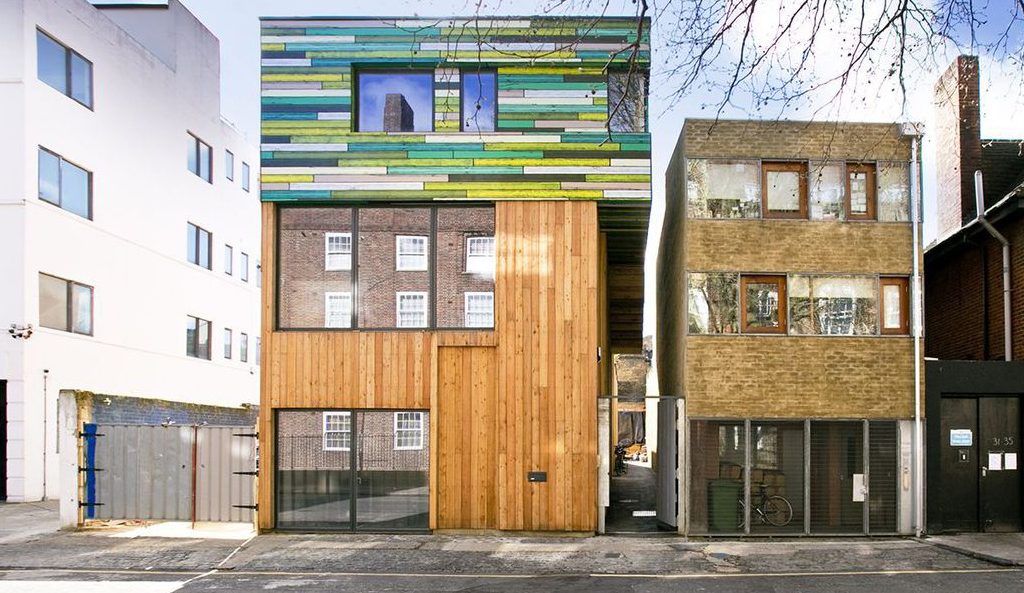
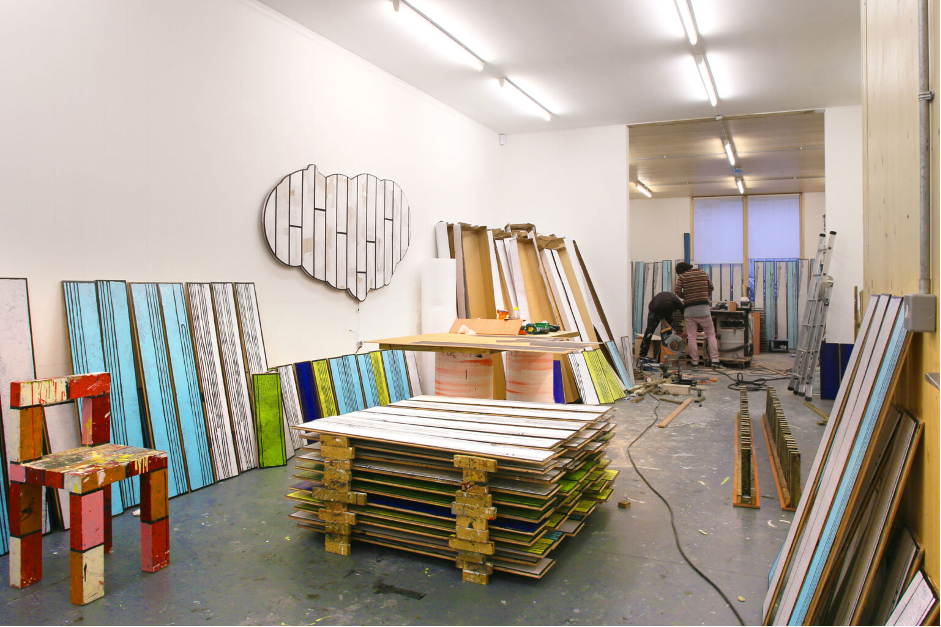
dRMM’s Woodblock House for and with artist Richard Woods brings infill aesthetics to the artist’s re-use ethic of upcycling and painting wastewood for his woodblock art working.
Over the last quarter of a century districts just east and north east of central London have become super-fashionable parts of the capital. In Whitechapel, Hoxton and Hackney, artists, designers, tech specialists, and not forgetting architects, have colonised these still deprived parts of the city, creating a lively and dynamic creative culture living cheek by jowl among these poorer communities. It’s not surprising, then, to find artist’s collaborating with architects to design and build one-off houses and homes for themselves.
This is the background to the £1.1 million Woodblock House, home and work studio of artist Richard Woods, a long-time friend of Alex de Rijke, dRMM’s founder-director. The house sits on a tight 257 m sq2 infill site, close to other artists and architects’ studios (Caruso St John’s studios are almost neighbours) and opposite mid-height council housing blocks, underscoring the neighbourhood’s diversity and social mix. At 11.8 m tall all four storeys are built from 121 m3 of timber (excepting the concrete slab), the structural CLT remains exposed on the three home floors. (Render has been applied to Woods’ studio’s ground floor walls as a fire safety precaution.) Clear separation between work and home spaces was required by Tower Hamlet’s Council planners, so the design follows the straight building line of the narrow passage running alongside the neighbouring building, the home entrance at the front, the studio close to the rear.
Asked why he wanted a wood house, Woods laughs, and refers to his surname, before adding that “I’ve always liked the feeling of wood and liked the idea of building with an agricultural material in the city.” He, and his children’s book illustrator wife, Jess, also felt that they wanted a home which was sustainable as possible. Woods and dRMM had already collaborated, Woods developing a signature multi-coloured wood tile or block which has been used on several dRMM projects, including Milton Keynes Museum timber tower and the Modern Art Oxford revamp. These re-painted ply wastewood pieces re-invent common timber perceptions into a colourful ‘pop-arty’ cladding and façade material, and are a main feature in the house, which was completed in 2013.
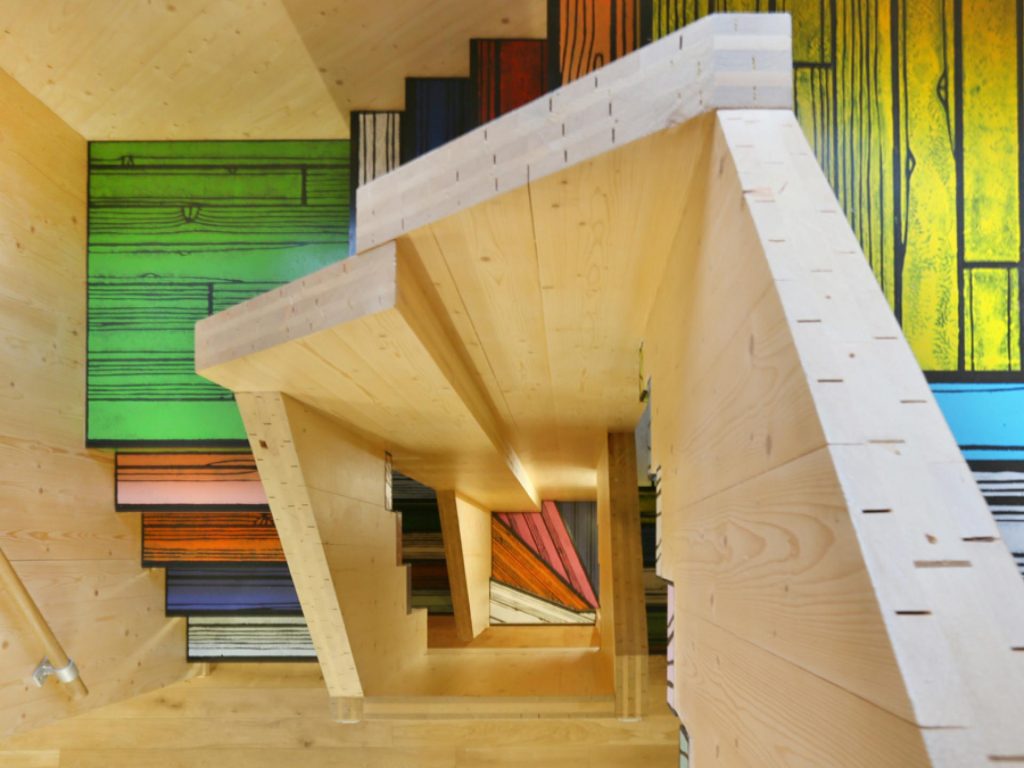
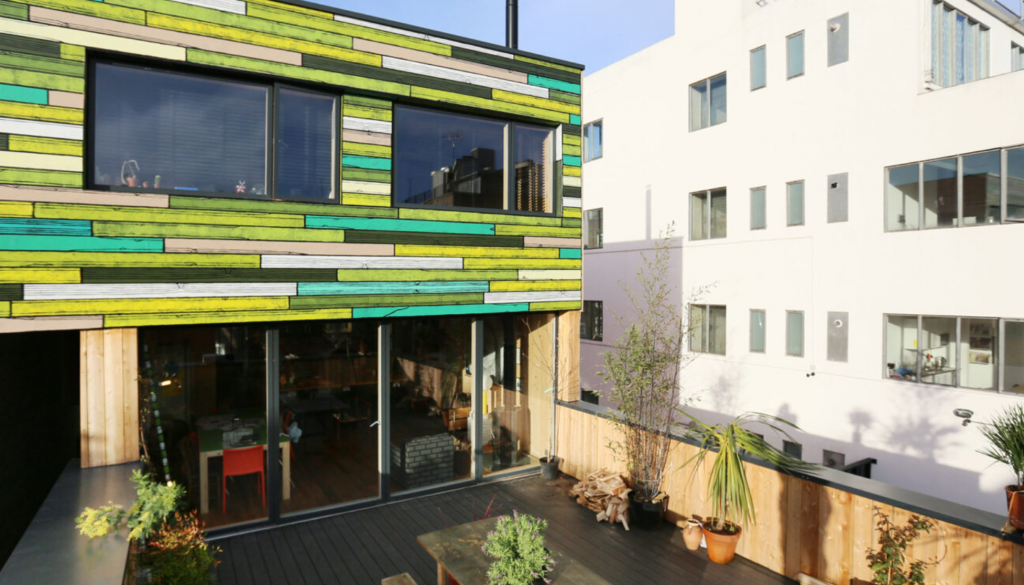
They’ve been applied both in the stairwell steps reaching from ground to fourth floor, and as larger decorative elements on or beside the immediate CLT stairwell wall-space, a simple waste-wood upcycling strategy for adding in an imaginative design element. The staircase void opens up into a spacious first-floor living area, while enabling considerable natural light to pour in in through roof lit windows. Outside, a spectrum of further green ‘woodblock’ tiles covers the rear façade wall, in front of the CLT and insulation, and viewable from the first-floor terraced garden, which also features a roof garden.
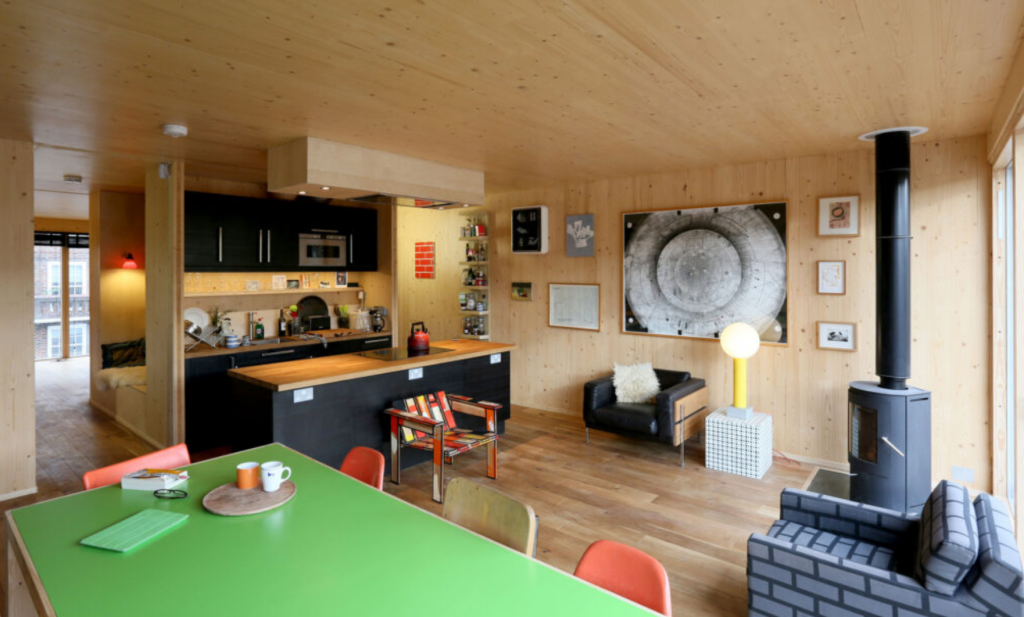
Talking about the homely open plan first floor, running – bar an island kitchen in the middle – Woodblock’s entire 20 m length, de Rijke invokes Corbusier’s Plan Libre, with the CLT walls blending in with Wood’s art works hanging on the walls. Conversely the second-floor bedrooms reflect Dutch RaumPlan thinking, and are considerably smaller, much more tightly organised bedrooms for the family of five. On all three family floors the CLT is fully part of the visible building, covering walls, floors and ceilings in contrast to many larger London CLT housing blocks where, for the main part, timber is hidden behind other surface materials, often because of insurance or client stipulation. The effect is noticeable, Woodblock House exuding a calm, relaxed and friendly ambience, while the different floors also clearly show, in de Rijke’s words, “what CLT can do without recourse to structural support.” On the top floor is a small second studio for Jess Woods, covering a smaller footprint and looking rather like a beach hut.
For de Rijke, WoodBlock House provides a contemporary example of a CLT Terrace House. “It is dRMM’s answer to a town house. We like to think of it as the first new timber house since the days of stick and thatch before the Great Fire of London in 1666.”
Therein lies the challenge. In London there are very few smaller urban CLT houses. Urban timber is about larger scale housing blocks and school buildings. Woods reports how friends are surprised by the timber building, often bringing up fire risk rather than how they might try something similar. While there were challenges with insurance and raising build funds including the mortgage, Woods says the relatively short build “couldn’t have been easier.” With Woodblock House long complete, while hardly straight-forward to realise, CLT and engineered timber homes and indeed entire low-rise terraces have become much easier to imagine.
This piece was written for the Austian timber architecture magazine Zuschnitt in 2019, but wasn’t published.