
Joensuu’s Metla Forest Research Centre

All Photos unless otherwise credited – Okke Kiviluoto/SARC and Jussi Tiainen
The Finnish timberbuild scene is a paradox. During the last century Europe’s most heavily forested country all but turned its back on timber as a core structural and building material. Only in the last ten years has a fundamental rethink begun and timber is beginning to be once again tested as a construction material for larger scale non-residential buildings, including the first at scale timber office, the Metla Forest Research Headquarters.
In spring 2002, the Finnish Forest Research Institute, Metla, announced a competition to design the Institute’s office building, the first significant all purpose, timber constructed offices in the country. The office building is the only research centre outside of the Helsinki metropolis, far to the east of the country, in the city of Joensuu. The heavily forested rural region, part of the Old Finnish kingdom of Karelia, has been haemorrhaging its population since the sixties. In an attempt to stay this outward flow, Joensuu’s Universitywas founded in 1968, followed by Government deciding to decentralise Metla as an organisation and subsequently to make Joensuu the primary research base in the region. With the autumn 2004 opening of one of the largest contemporary timber buildings in the country to date, Metla’s research was refocused again on the centre doubling the research staff, to approximately 100 researchers.
Central to the competitions’ aim was a flexible modern office structure, which could compete with the traditional modern materials, steel and concrete, used as commonly in Finland as in the rest of Europe, to provide the versatility of mainstream office building, but with a timber based structural system. The winning entry came from the established Helsinki SARC practice who turned some orthodox office techniques into an experiment in applying the increasingly popular massive wood techniques and technology in the Nordic countries to the specific requirements of office design and architecture.
The research centre comprises two office blocks covering 60m2, one L shaped, the other a straight section, sited parallel to each other. Buffering and joining these is a third component, “a dramatically glazed hallway block, revealing a system of four double v form struts splaying up to the open ceiling. This hall completes three sides of the sites’ rectangular horseshoe, the fourth face is left open as an entrance to the alcove courtyard nestling within the interior walls. The timber component is almost entirely spruce, either original, reclaimed, or glulam; the result is a series of sharp, austere boxes, and a mix of windowed and closed external timber facades, transmitting a clear and unequivocal signature, and signalling continuity with Nordic functionalist modernism, which remains so strong across the Nordic world.


Photos – Metla/Erkki Oksanen
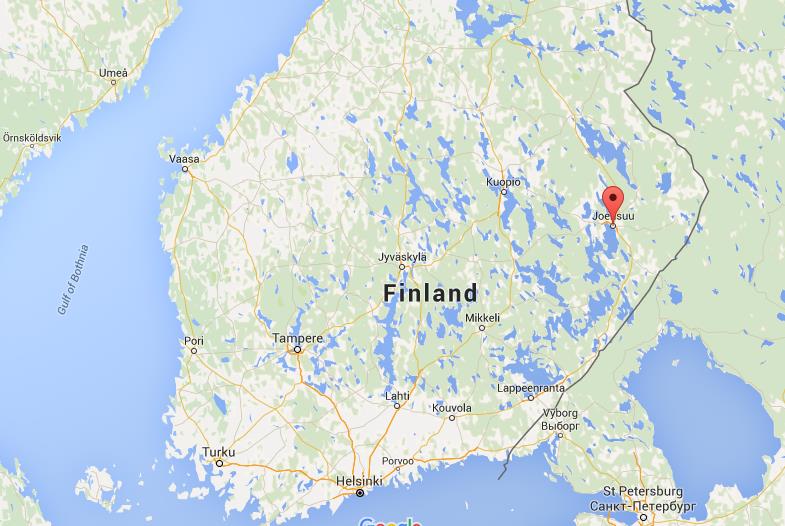

Joensuu: on the map, and Joensuu University campus from above, with the Metla Forest Research centre in the upper right of the picture


The hallway struts are 20 cm x 20 cm rectangular glulam pine, square in section, with the two central tilted strut columns some 20 metres apart from each other. Dramatic and expressive in themselves, the double v struts are visually counterbalanced by the addition of a free form windowless auditorium, with a thick aspen mantle of shingle, cutting through the glass facade – half in the hallway and half out on the courtyard. The auditorium’s upturned boat organicism seats san audience of seventy and provides something of a counterpoint to both the expressivity of the struts, and the overall cool Nordic aesthetics.
If this is the focal centre of the building, the visible v strut system also outlines how the combination of an experimental hollow massive timber structural system to the three storey offices, together with large span, vertical tilted post and beam glulam framing, (here 40 x 40cm square), can be utilised to ensure office space as large and versatile as any steel and concrete office structure. Through the design SARC were expressing confidence that this combination could be effective, which would win them the competition. Once appointed SARC began by constructing a life size model in order to test and confirm the flexibility of the combined materials through load bearing tests, to ensure that office reorganisation would be easy and straightforward in the future. Nonetheless these timber structural elements are supplemented by three concrete towers to each side of the hall, and the corner of the L block. The towers contain elevators, toilets and ductwork for the building.
Spruce is also used in the external finishes of the building around the perimeter, which are a mixture of closed walls, a vertical mosaic of 30 by 70cm reclaimed logs from two Joensuu buildings, and lining for the windowed buildings’ faces’ with long finger narrow 1.8m pine windows. The timber used was pre-manufactured off-site and is all local to the Karelian region.
This was the first time a timber system which set itself the task of competing with steel and concrete without constraining the building design had been attempted in Finland. The costs were hardly cheap, coming in at 14 million Euro’s. Yet the project architect, Okke Kiviluoto, believes that when integrated into the manufacturing process such timber office buildings can easily become competitive. ˜Everything is new, and shows it can be done,” he says. The result is both a regional showpiece for the Metla Building, turning Nordic architectural eyes towards Joensuu, and an intriguing experiment in office timber functionalism, which likely shall take further steps in the near future.
From the beginning of 2015 Metla became part of the Natural Resources Institute Finland, which goes by the name of Luke (short for Luonnonvarakeskus)