
From Shells to Bubbles
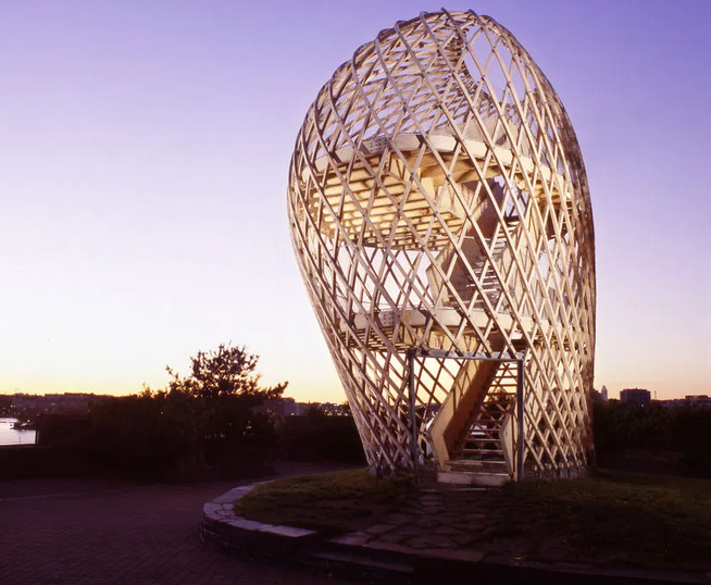
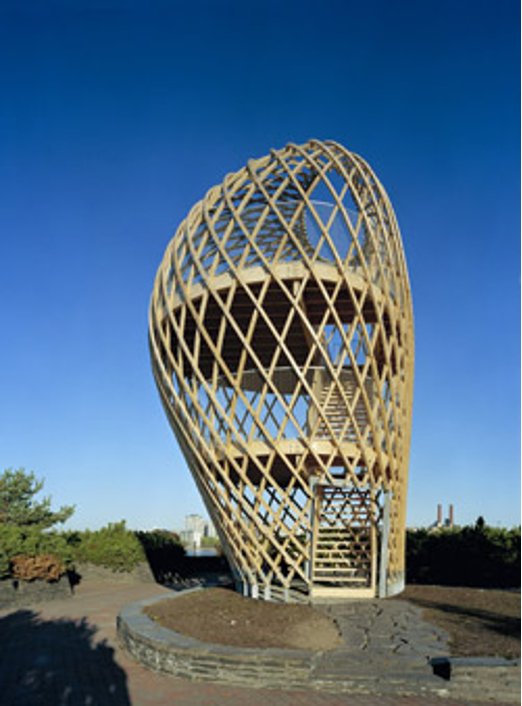
Helsinki Zoo’s ‘Bubble’ – Unless otherwise stated all photos by Jussi Tiainen
A Wood Studio student designed and built the Nordic world’s first gridshell, the Bubble.
At the turn of the century Finnish construction, Government, developers and the country’s architects, were only just beginning to consider the prospects of timber as twenty first century. Projects like Sibelius Hall in Lahti, and the METLA Forest Research headquarters in the eastern Karelia city of Joensuu, are the first at scale timber buildings, for a century. Oulu’s Wood Town project is also new, although according to Pekka Heikkinen, director of the Wood Studio at Helsinki’s Technical University (today Aalto University), they are all indications of a cautious groundswell shift in perception regarding timber buildings.
“People,” Heikkinen says, “see through the examples that there are buildings, and think that, yes, a municipal building can be constructed out of wood, and done in the way it was done in traditional housing.” Sibelius Hall has been a hit with the Finnish public at large because of, he is sure, the warmth of the wood. “The warmth could not have been conveyed in concrete. So, people increasingly feel open to timber.”
This is echoed in current student enthusiasm on the Wood Studio masters at Helsinki’s University of Technology, a highlight of which is a year-long live project being undertaken by the students. At present, Heikkinen says, there is a wave of enthusiasm for lightweight wooden structures in the studio. One early example of this wave of enthusiasm turned into Wood Studio’s best-known project, a Mies Award nomination and the attention of worldwide architectural media. In 2002 one of the year’s intake of students, Ville Hara, designed what was colloquially dubbed Kupla, or ‘the Bubble.’ It’s also actually the first Nordic gridshell.
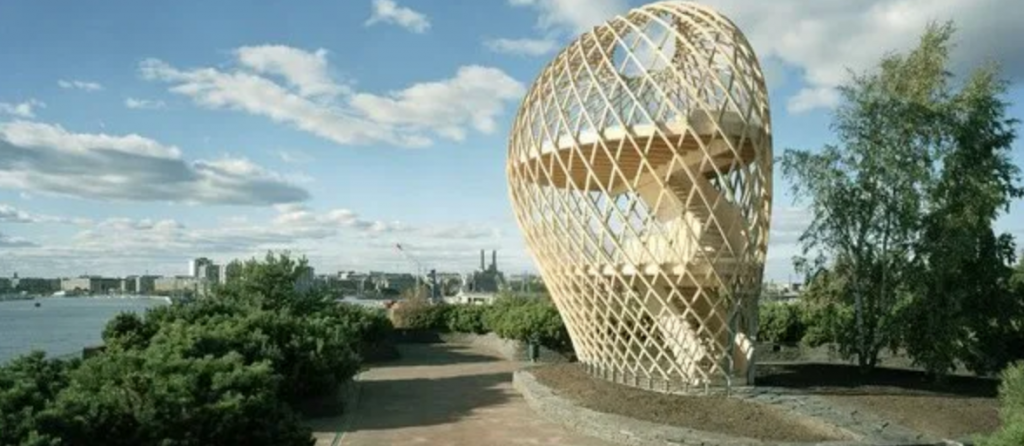
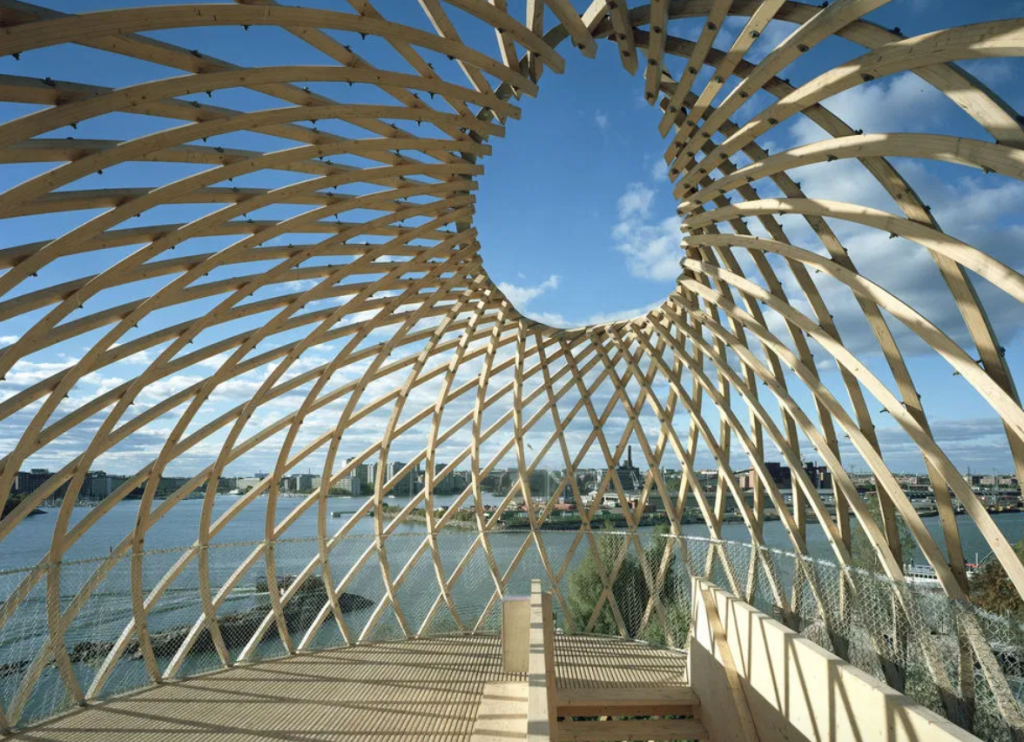
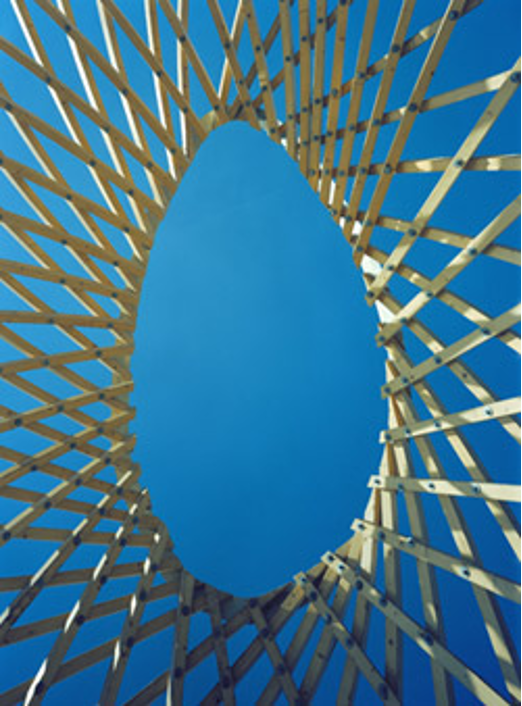
Helsinki Zoo Bubble – Images by Jussi Tiainen
Hara was among the 2002 year of students given a competition project of designing a viewing platform on the brow of the Helsinki’s Korkeasaari zoo, which faces inland towards the city. He came up with a spiralling timber lattice structure meeting in an ovoid apex, open at the top to the sky. The form isn’t too far from a reclining, abstracted head, even if locals refer to it as ‘the bubble’. Hara says that the biomorphic shape emerged equally organically, out of an immersion with the site, and wanting to build up from the centre of the viewing area without removing any of the adjacent trees. In the University’s studio he worked on the slats ArchiCAD modelling and building a two-metre model. Together both suggested it would be relatively easy to achieve. The model won him the competition, and Hara continued testing the bending of prototype joints in the University’s Civil Engineering department. With this also positively accomplished, through Finland’s short summer months Hara and a group of some eight fellow HUT student volunteers, some from different parts of Europe, set about constructing the real thing, with two floors of standing space fitted horizontally into the tower.
Hara says this is impossible to repeat, because even this modest structure was much too expensive to be commercially viable. If expense and labour intensiveness were not issues, Hara envisages that the structure would be potentially realisable on a large scale, as an office block for instance, although acknowledges that there could be a problem with fire for any larger scale structure.
Whereas gridshells are primarily more horizontal forms, hugging the ground rather than reaching up, Hara’s bubble structure introduces the speculative possibility of vertical tower-formed gridshells. As a biomorphic form the bubble has an elegance, while not at odds with Finnish Neo-Modernism, which also introduces the gridshell to these northern shores for the first time. In the months after Finnish PR companies picked up on the project, and it became the poster-child in various international tourism campaigns across Europe and elsewhere. Hara graduated and went to work at SARC, focusing on structural timber glulam needed for the METLA project, before co-forming Avanto, the studio soon becoming one of the country’s best known, projecting a playful, youthful architectural sensibility. At present the Bubble is, in Nordic terms, an entertaining one-off, Hara, when I visited, saying how pleased he is with it, particularly for children visiting the zoo. What happens next with this incipient Nordic cult of the gridshell is an open question. Whether gridshells – as form and structure are taken further – in both the Finnish and Nordic architectural context, remains appealingly wide open
Sometime ago I interviewed Ted Cullinan about the Weald and Downland Museum Gridshell. Is it modernist or post modernist?, I asked. “Modernist” came the immediate and unhesitating reply. Others would beg to differ, such as the Victoria and Albert Museums’s Zoomorphic exhibition curator. Perhaps we are in the midst of the organic re-aligning itself, so that there will be many biomorphisms’ in the near future; ones which will bear allegiance to the continuing story of Nordic Neo Modernism and others which will become exemplars of a new international style.
And Heikkinen? Well, he seems delighted with the emergence of Northern biomorphic form, as expressed by Moby Dick and the Bubble. But will the Nordics really ever jump to the biomorphic beat? “I’m very interested that these architects have lost or forgotten the tradition of the functionless box, and rather see the building as connected to and coming from nature.” As to why it is not happening at a more insistent pace he isn’t sure; maybe it’s something to do with Nordic self-control and the fact that the Nordic Neo Modernism is “quite simple, quite rectangular, quite as they have always been.” And then he quotes a furniture maker, “We build architecture on wood, making architecture in wood.” But, said the furniture maker, “we should make wood in architecture.”
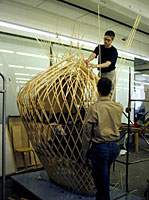
Hara working on the model at
HUT’s Wood Studio
www.woodfocus.fi – website of wood in construction from the Finnish Federation of Forest Industry
www.hut.fi/Yksikot/Osastot/A/engl/woodprog/ – the wood architecture and engineering course at Helsinki University of Technology
www.sarc.fi – for information on the METLA Forest Research Institute building
www.lahti.fi/sibeliustalo/in_english/frames.html – The Sibelius Hall website